New OGEA-101 Exam Guide & Valid OGEA-101 Exam Sample
Wiki Article
2026 Latest FreeDumps OGEA-101 copyright and OGEA-101 copyright Free Share: https://drive.google.com/open?id=1HCLuo90TtzH3NvflFialDoEqKV_D_fTr
In order to let all people have the opportunity to try our OGEA-101 exam questions, the experts from our company designed the trial version of our OGEA-101 prep guide for all people. If you have any hesitate to buy our products. You can try the trial version from our company before you buy our OGEA-101 Test Practice files. The trial version will provide you with the demo. More importantly, the demo from our company is free for all people. You will have a deep understanding of the OGEA-101 preparation materials from our company by the free demo.
If you search for exam materials for your coming exam, you will find that there are so many websites to choose from. And our website is the most reliable one. You can just compare the quality and precision of the OGEA-101 exam questions with ours. Then you will find that our OGEA-101 Study Materials are the best among all the study sources available to you. And we have become a famous brand in this career. You won't regret for your choice.
Pass Guaranteed Quiz 2026 Marvelous The Open Group New OGEA-101 Exam Guide
Do you like to practice study materials on paper? If you do, you can try our OGEA-101 exam dumps. OGEA-101 PDF version is printable, and you can study anywhere and anytime. We offer you free demo for you to have a try before buying, so that you can have a better understanding of OGEA-101 Exam Dumps what you are going to buy. Free update for 365 days is available, and you can get the latest information about the OGEA-101 exam dumps timely. The update version will be sent to your email automatically.
The Open Group OGEA-101 Exam copyright Topics:
| Topic | Details |
|---|---|
| Topic 1 |
|
| Topic 2 |
|
| Topic 3 |
|
| Topic 4 |
|
| Topic 5 |
|
| Topic 6 |
|
| Topic 7 |
|
| Topic 8 |
|
The Open Group TOGAF Enterprise Architecture Part 1 Exam Sample Questions (Q46-Q51):
NEW QUESTION # 46
Refer to the table below: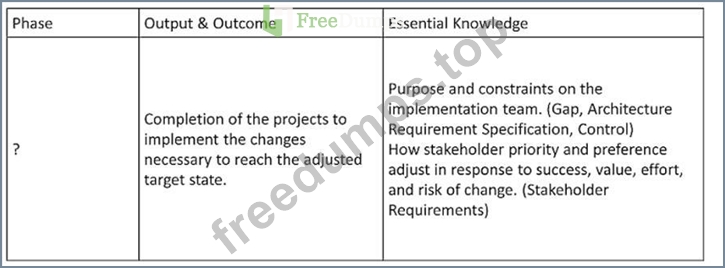
Which ADM Phase does this describe?
- A. Phase G
- B. Phase F
- C. Phase E
- D. Phase A
Answer: A
Explanation:
The table describes the output, outcome, and essential knowledge of an ADM phase that oversees the implementation of changes necessary to reach the adjusted target state. This corresponds to Phase G, also known as Implementation Governance, which ensures that the architecture defined in earlier phases is realized, and it oversees the development and implementation of projects to align with this architecture. The essential knowledge required during this phase includes understanding constraints on the implementation team and adjusting stakeholder priority and preference in response to success, value, effort, and risk of change. References: TOGAF Version 9.1 - 1
NEW QUESTION # 47
Which phase of the ADM has the purpose to develop an Enterprise Architecture Capability?
- A. Preliminary Phase
- B. Phase B
- C. Phase A
- D. Phase G
Answer: A
Explanation:
According to the TOGAF Standard, 10th Edition, the Preliminary Phase of the Architecture Development Method (ADM) has the purpose to develop an Enterprise Architecture Capability 1. An Enterprise Architecture Capability is the ability of the organization to perform the activities and tasks related to Enterprise Architecture, such as defining the scope, principles, vision, governance, and stakeholders of the architecture. The Preliminary Phase also establishes the architecture framework, the architecture repository, the architecture tools, and the architecture team 1. The other options are not correct, as they have different purposes in the ADM. Phase G: Implementation Governance has the purpose to ensure that the implementation projects conform to the target architecture 2. Phase A: Architecture Vision has the purpose to define the scope, stakeholders, business drivers, and objectives of the architecture project 3. Phase B: Business Architecture has the purpose to describe the baseline and target business architecture, and to identify the gaps between them . Reference: 1: TOGAF Standard, 10th Edition, Part II: Architecture Development Method, Chapter 6: Preliminary Phase. 2: TOGAF Standard, 10th Edition, Part II: Architecture Development Method, Chapter 18: Phase G: Implementation Governance. 3: TOGAF Standard, 10th Edition, Part II: Architecture Development Method, Chapter 12: Phase A: Architecture Vision. : TOGAF Standard, 10th Edition, Part II: Architecture Development Method, Chapter 13: Phase B: Business Architecture.
NEW QUESTION # 48
Complete the following sentence. In the ADM, documents which are under development and have not undergone any formal review and approval process are called______ Documents which have been reviewed and approved are called ______
- A. "concept" - "deliverable"
- B. "Version 0.1" - "Version 1.0"
- C. "draft" - "approved"
- D. "draft"- "finalized"
Answer: C
Explanation:
According to the TOGAF Standard, 10th Edition, documents which are under development and have not undergone any formal review and approval process are called draft documents, while documents which have been reviewed and approved are called approved documents 1. Draft documents are typically marked with a version number of 0.x, indicating that they are incomplete or provisional. Approved documents are typically marked with a version number of 1.0 or higher, indicating that they have been finalized and authorized. The other options are not correct, as they are not the terms used by the TOGAF Standard to distinguish between documents under development and documents that have been reviewed and approved. The terms "finalized",
"concept", "deliverable", and "Version 0.1" and "Version 1.0" are not specific to the TOGAF Standard, and they may have different meanings or interpretations in different contexts. References: 1: TOGAF Standard,
10th Edition, Part II: Architecture Development Method, Chapter 7: Applying Iteration to the ADM, Section
7.2.3 Document Categorization.
NEW QUESTION # 49
Which of the following are two of the architecture domains that are considered as subsets of an overall Enterprise Architecture?
- A. Strategy, Enterprise
- B. Vision, Target
- C. Business, Technology
- D. Technology, Digital
Answer: C
Explanation:
In the TOGAF Standard, the concept of an Enterprise Architecture is broken into several primary architecture domains. These domains provide a structured way to describe the enterprise from multiple perspectives that collectively support transformation and governance. TOGAF specifies four core architecture domains:
Business Architecture, Data Architecture, Application Architecture, and Technology Architecture. These domains, when combined, form a comprehensive view of how the enterprise functions, how information flows, how systems interact, and what technologies support the organization.
Among the choices provided, only Business and Technology are officially recognized architecture domains in TOGAF. The Business Architecture describes business strategy, governance, organization, and key processes.
The Technology Architecture defines the logical and physical technology infrastructure necessary to support mission-critical applications and data. The other answer options do not represent TOGAF architecture domains; for example, "Strategy," "Vision," "Target," or "Digital" are not formal architecture domains in TOGAF. Thus, the pair that correctly identifies subsets of an enterprise architecture according to the TOGAF framework is Business and Technology Architecture.
NEW QUESTION # 50
Consider the following descriptions of deliverables consumed and produced across the TOGAF ADM cycle.
* General rules and guidelines, intended to be enduring and seldom amended, that inform and support the way in which an organization sets about fulfilling its mission
* A set of quantitative statements that outline what an implementation project must do in order to comply with the architecture.
* A document that is sent from the sponsoring organization to the architecture organization to trigger the start of an architecture development cycle
* The scope and approach that will be used to complete an architecture development cycle Complete the sentence. Deliverable 3 is the, deliverable 4 is a deliverable from
- A. Architecture Definition Document, Phase H
- B. Stakeholder Map, Phase G
- C. Request for Architecture Work, Phase A
- D. Architecture Requirements Specification, Preliminary Phase
Answer: C
Explanation:
In TOGAF's ADM, the Request for Architecture Work is the deliverable issued by the sponsoring organization (or stakeholder) to formally request that the architecture team perform a full architecture development cycle. That corresponds to your "deliverable 3." Then, the architecture team responds by producing a Statement of Architecture Work (in Phase A), which defines the scope, constraints, approach, and highlevel tasks for the architecture development. That is your "deliverable 4" (the scope and approach). Thus deliverable 3 is the Request for Architecture Work, and deliverable 4 is generated in Phase A. The Request triggers the cycle; the Statement of Architecture Work (in Phase A) lays down how the architecture work will proceed, including scoping and approach.
NEW QUESTION # 51
......
The The Open Group OGEA-101 web-based practice test software is very user-friendly and simple to use. It is accessible on all browsers (Chrome, Firefox, MS Edge, Safari, Opera, etc). It will save your progress and give a report of your mistakes which will surely be beneficial for your overall exam preparation.
Valid OGEA-101 Exam Sample: https://www.freedumps.top/OGEA-101-real-exam.html
- Quiz OGEA-101 - TOGAF Enterprise Architecture Part 1 Exam –Reliable New Exam Guide ???? Go to website “ www.troytecdumps.com ” open and search for ➤ OGEA-101 ⮘ to download for free ????New OGEA-101 Exam Prep
- Pass Guaranteed Useful OGEA-101 - New TOGAF Enterprise Architecture Part 1 Exam Exam Guide ???? Simply search for { OGEA-101 } for free download on ☀ www.pdfvce.com ️☀️ ????OGEA-101 Latest Test Format
- OGEA-101 latest The Open Group certification exam questions and answers published ???? Easily obtain ☀ OGEA-101 ️☀️ for free download through “ www.testkingpass.com ” ????Valid Exam OGEA-101 copyright
- Quiz 2026 High-quality The Open Group New OGEA-101 Exam Guide ???? Search on ➡ www.pdfvce.com ️⬅️ for ▛ OGEA-101 ▟ to obtain exam materials for free download ????OGEA-101 Test Pattern
- OGEA-101 latest The Open Group certification exam questions and answers published ???? Download 【 OGEA-101 】 for free by simply searching on ▷ www.troytecdumps.com ◁ ????Sample OGEA-101 Questions Answers
- Valid New OGEA-101 Exam Guide - 100% Pass OGEA-101 Exam ???? Search for ✔ OGEA-101 ️✔️ and download it for free immediately on ⏩ www.pdfvce.com ⏪ ????OGEA-101 Reliable Exam Voucher
- Boost Your Confidence with Online The Open Group OGEA-101 Practice Test Engine ???? Open ▶ www.prepawayexam.com ◀ enter ⮆ OGEA-101 ⮄ and obtain a free download ????OGEA-101 Valid Mock Test
- Latest OGEA-101 Exam Papers ???? Latest OGEA-101 Exam Papers ???? Test OGEA-101 Dates ???? Search for 「 OGEA-101 」 and download exam materials for free through [ www.pdfvce.com ] ????New OGEA-101 Exam Pdf
- Pass Guaranteed 2026 Efficient OGEA-101: New TOGAF Enterprise Architecture Part 1 Exam Exam Guide ???? Open ⮆ www.prepawayete.com ⮄ and search for ☀ OGEA-101 ️☀️ to download exam materials for free ????Official OGEA-101 Study Guide
- OGEA-101 Valid Mock Test ???? OGEA-101 Valid Mock Test ???? OGEA-101 Test Guide Online ???? The page for free download of ➤ OGEA-101 ⮘ on ➽ www.pdfvce.com ???? will open immediately ????OGEA-101 Prepaway Dumps
- OGEA-101 Test Torrent ???? OGEA-101 Test Pattern ???? Valid OGEA-101 Vce Dumps ???? Download ➠ OGEA-101 ???? for free by simply entering ➠ www.examcollectionpass.com ???? website ????OGEA-101 Test Pattern
- bd.enrollbusiness.com, www.stes.tyc.edu.tw, loriisxk818267.thenerdsblog.com, school.kitindia.in, www.stes.tyc.edu.tw, www.stes.tyc.edu.tw, training.yoodrive.com, cosmeticformulaworld.com, www.stes.tyc.edu.tw, honeyvxjw461336.blogrenanda.com, Disposable vapes
DOWNLOAD the newest FreeDumps OGEA-101 copyright from Cloud Storage for free: https://drive.google.com/open?id=1HCLuo90TtzH3NvflFialDoEqKV_D_fTr
Report this wiki page